


US Grid Capacity and Modernization: Powering Tomorrow Through Yesterday’s Infrastructure
Mar 11, 2026
We poured the foundation of America’s electrical grid in the 1960s, and then — for all practical purposes — we stopped building. Oh, we’ve dressed it up over the decades. Some fiber optics here, a scattering of smart meters there, a fresh coat of rhetorical paint every time a politician needs an infrastructure talking point. But underneath the cosmetic upgrades? Same skeleton. Same brittle transmission lines. Same patchwork system groaning under the weight of a twenty-first-century electrical load it was never engineered to carry.
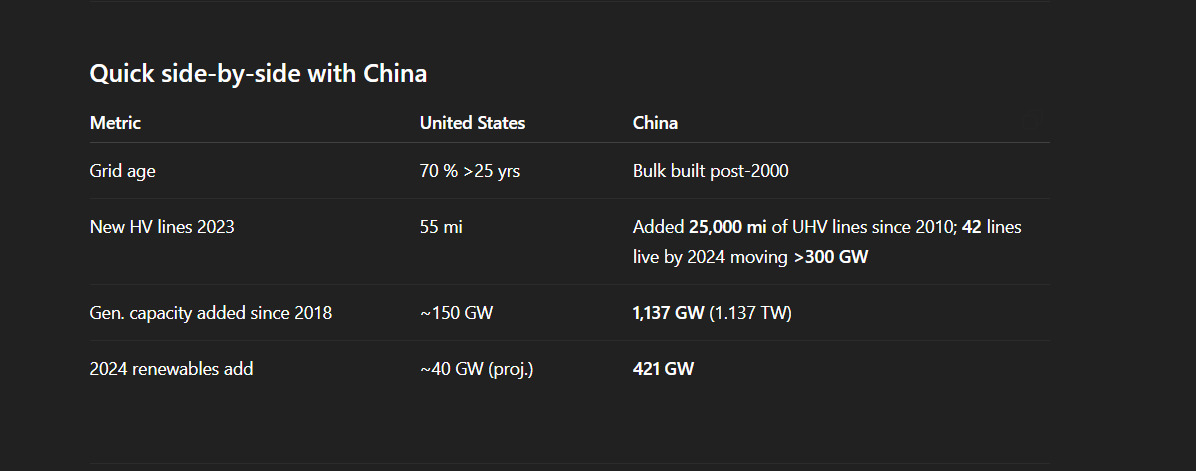
More than 70% of America’s transmission lines have been in service for over a quarter century. That’s not a statistic you file away and forget. That’s a diagnosis. The average component in the U.S. grid is like a retired boxer who can still stand upright and throw a jab, but one solid hit away from going down for good.
And the problem isn’t just age. It’s pace. In 2023, the United States added a grand total of 55 miles of new high-voltage transmission line. Let that number settle in your mind for a moment. In a country that’s lighting up data centers the size of small towns and plugging in millions of electric vehicles, we managed to lay down 55 miles of new electrical backbone. You can drive that distance in under an hour without breaking the speed limit. China, operating on an entirely different timeline, added roughly 25,000 miles of ultra-high-voltage line over the past decade. Forty-two UHV corridors now shuttle more than 300 gigawatts of power across their continent-sized territory.
That’s not development. That’s conquest by infrastructure.
Falling Behind in a Race We Pretend Isn’t Happening
Let’s be honest about something: the American grid didn’t sleep through the modernization era. It just kept hitting the snooze button. And every time the alarm went off — Enron’s implosion, the massive 2003 blackout, the Texas freeze of 2021, California’s wildfire-triggered shutoffs — we responded with whitepapers and task forces instead of steel and cable.
The raw numbers paint a picture that’s hard to argue with. Roughly 1,251 miles of all-voltage transmission lines were added in 2023. The country spent upward of $25 billion on grid-related work that year. But the vast majority of that spending went to maintaining what already exists, not expanding capacity. Meanwhile, congestion and systemic inefficiencies are bleeding the economy of an estimated $20 billion annually. That’s the equivalent of paying a master mechanic top dollar to rotate the tires on a car that doesn’t have an engine.
China, meanwhile, is playing an entirely different sport. Their total installed generation capacity sits near 2,990 gigawatts. The United States? Approximately 1,300 GW. The European Union? Roughly 1,000 GW. China alone eclipses both. Add Japan, India, Brazil, and the entire African continent to the Western tally, and China is still ahead.
But this isn’t purely a story about scale. It’s about velocity. China added more than 300 gigawatts of renewable generation capacity in 2023 alone. To put that in perspective, that single year of Chinese renewable buildout exceeded the entire generation capacity of Germany, the United Kingdom, and France combined.
While they’re moving with the intensity of a startup that’s discovered unlimited funding, we’re wandering around like a distracted animal in a field — nibbling at one patch of grass, then another, then a third, never committing long enough to any single approach to actually get nourished. Translation: we talk endlessly, build almost nothing at scale, and drown in our own permitting bureaucracy while congratulating ourselves on having a “robust national conversation.”
The Hidden Load: AI and the Coming Power Crisis Nobody’s Discussing
Everyone’s talking about artificial intelligence models. The breakthroughs. The valuations. The race for dominance. What almost nobody’s talking about is what physically powers all of it.
The explosion of AI and data infrastructure is about to deliver a gut punch to the American grid that most people haven’t begun to comprehend. Data centers already consume approximately 2.5% of total U.S. electricity. But with the rapid scaling of generative AI, that figure could realistically double by 2030 — and possibly sooner, given the pace of current buildout commitments.
A single hyperscale data center can devour as much electricity as 50,000 homes. And the construction pipeline is accelerating, not slowing. Hundreds of new AI-focused facilities are in various stages of development across the country. Microsoft, Google, Meta, and Amazon have collectively committed tens of billions of dollars to expanding their computational capacity. The Nvidia GPUs grabbing headlines are just the visible tip of the iceberg. Behind them sit vast racks of servers that run hot and hungry, around the clock, every day of the year.
And unlike a manufacturing plant that can throttle back during a heatwave or a demand spike, these facilities don’t have an off switch. They run continuously, and every second of unplanned downtime translates into millions of dollars in lost revenue and degraded service.
We are constructing the digital future at breakneck speed while systematically ignoring the physical foundation it depends on. And this isn’t some abstract concern that belongs in a 2035 planning document. It’s already manifesting — in regional capacity constraints, in spiking industrial electricity rates, and in localized grid congestion that’s forcing difficult choices about who gets power and who waits.
The American grid was designed for factories and refrigerators. We’re now asking it to power simulated intelligence — and doing so through transmission lines old enough to remember when rotary phones were cutting-edge technology.
Strangled by the Bureaucracy We Built to Protect Ourselves
You want nuclear power? So does nearly every serious energy analyst in the country. But good luck actually building it. Between interminable review boards, cascading environmental litigation, and construction costs that balloon with every year of delay, the United States has been dragging its feet on new nuclear capacity while China greenlights reactor after reactor on timelines that would make an American project manager weep. We’ve been having the same “next-generation nuclear” conversation on an endless loop since the Clinton administration. China stopped talking about it years ago. They just build.
The grid itself is a hostage of its own regulatory apparatus. Want to construct a new transmission line in the United States? Steel yourself. The median federal permitting timeline currently exceeds nine years. That’s not forward planning. That’s institutional paralysis dressed in procedural clothing.
This isn’t fundamentally a capacity problem. It’s a decision-making problem. And the price tag for indecision keeps climbing.
Grid congestion alone hemorrhages an estimated $20 billion annually in squandered economic potential. Meanwhile, the artificial intelligence arms race is setting up shop in our backyard at a pace that makes the permitting timeline look almost satirical. Data centers, cryptocurrency mining operations, electric vehicle charging networks — none of them are going to politely wait for our advisory committees to reach consensus. The demand is here. It’s measurable. It’s growing. And the grid? Still standing in line at the DMV, clutching a number and hoping someone calls it before closing time.
And what’s our response? We circulate buzzwords. “Smart grid.” “Resilience.” “Energy democracy.” Slogans that sound progressive in a consultant’s slide deck but produce exactly zero megawatts of new capacity. We don’t need another vision document. We don’t need another blue-ribbon panel. We need execution. Steel in the ground. Cable strung between towers. Actual electrons flowing through actual infrastructure that didn’t exist last year.
Because the next major blackout won’t be a philosophical debate. It’ll be a physical event — with real consequences for real people who assumed the lights would always come back on.
The American Delusion: Assuming the Future Will Wait for Us
The psychology at work here matters as much as the engineering. There’s a deeply embedded American assumption — call it a national cognitive bias — that the future naturally bends in our direction. That if we theorize long enough, convene enough panels, and publish enough roadmaps, a modernized grid will somehow materialize from the collective output of our think tanks and policy institutes. But infrastructure doesn’t respond to aspirations. It responds to deployment. To cranes and concrete and crews working in the field.
And we’re not deploying. Not at the scale the moment demands. Not with anything resembling the urgency the situation requires.
The U.S. electrical grid is attempting to run a digital-age civilization through analog-era arteries. It’s the equivalent of asking a vinyl record player to stream a high-definition audio service. You can tweak the needle, polish the platter, even rewire the tone arm — but you’re still working with fundamentally the wrong tool for the job at hand.
This isn’t fatalism. It’s not doom-mongering. It’s a straightforward assessment of where things stand in 2026. The United States isn’t doomed. But it is dangerously, measurably behind — and the gap is widening, not closing.
Because while we’re still debating whether the future should run on solar or nuclear or hydrogen or offshore wind — staging the same jurisdictional turf wars and ideological skirmishes we’ve been staging for two decades — China is building all of it. Simultaneously. At scale.
And they are not waiting for us to catch up.

The Psychology of Slow Collapse: Fast Fashion Thinking Applied to Critical Systems
This story isn’t ultimately about wires and watts and transformer stations. It’s about mindset. The United States isn’t suffering from a shortage of engineering talent or technical capability. What it’s suffering from is a collective attention deficit — an inability to sustain focus on problems that don’t produce immediate, visible crises.
We’ve started treating critical infrastructure the way we treat disposable clothing — as something cheap, replaceable, and perpetually someone else’s responsibility to maintain. We’ve been wearing the same frayed electrical sweater for four decades, patching it hastily every time it tears, then blaming the weather when it rips open again in the same spot. And because the lights usually come back on after an outage, we’ve convinced ourselves the system is fundamentally sound. It isn’t. It’s fundamentally lucky. And luck, as any honest engineer will tell you, is not a design specification.
Mass psychology isn’t demanding action because the failures — so far — have been localized and temporary. They happen in relative silence. A regional brownout here. A transformer fire there. A rural community that loses power for three days while the rest of the country scrolls past the headline. The crisis doesn’t feel real until it’s your server farm going dark, your electric vehicle stranded with a dead battery, your town blinking out while the community five miles down the road keeps humming along as if nothing happened. That’s when the abstraction becomes personal. Not before.
This is the same psychological pattern that leads people to ignore warning signs in financial markets, in their own health, in every domain where gradual deterioration masquerades as stability. We’re addicted to cheap fixes. We’re allergic to deep, sustained, unglamorous work. And we’re dangerously overconfident that tomorrow will closely resemble yesterday — because yesterday, the lights came on when we flipped the switch.
But grids, like bodies and investment portfolios, have limits. They can absorb neglect for a remarkably long time. They can compensate, reroute, and improvise. Until one day they can’t. And this grid — America’s grid, the backbone of the world’s largest economy — is well past the point where improvisation qualifies as a strategy.